Published August 11, 2026 · Updated September 22, 2026 · 13 min read
The short answer
OC Solar's Tesla Powerwall 3 installation range is $9,995–$15,995, as of September 2026. $9,995 is for a basic installation with Participate Energy. Final pricing depends on the custom configuration and selected plan. Garage or outdoor placement, distance from the battery to the main service panel, whole-home or partial backup, and a Backup Switch or Gateway all affect the installation scope. Compare equivalent plan terms and backup scope across battery brands.
By Vinnie Curcie, Founder & CEO, OC Solar · Reviewed by Ashton Curcie, Chief Operating Officer
What does home battery backup cost in California?
OC Solar's Tesla Powerwall 3 installation range is $9,995–$15,995, as of September 2026. $9,995 is for a basic installation with Participate Energy. Final pricing depends on the custom configuration and selected plan. Garage or outdoor placement, distance from the battery to the main service panel, whole-home or partial backup, and a Backup Switch or Gateway all affect the installation scope. Our other published battery ranges are $13,000–$17,000 for Enphase IQ Battery 10C and $15,000–$19,000 for FranklinWH aPower 2. These offers can have different payment and ownership terms; compare equivalent proposals.
Why a range and not a sticker price? Because the battery itself is only part of the project. Backup controls, mounting, wiring and conduit, permits, inspection, utility approval, and any main-panel or sub-panel work all belong in the scope, and each one moves the total. A quote that looks cheaper because it quietly omits the backup gateway or the panel upgrade is not a lower price — it is a smaller project. Our California solar battery cost guide breaks down the full scope line by line, and the Tesla Powerwall cost guide covers what moves the price on the most popular unit.
The rest of this guide covers why batteries went from luxury to standard equipment in California — NEM 3.0 export economics, time-of-use rates, and outage reliability — plus how to size one, whether you can add a battery without solar, and how the three leading batteries compare.
Pricing note, September 2026: $9,995 is for a basic installation with Participate Energy. Final pricing depends on the custom configuration and selected plan. Compare the ownership/payment terms and installation scope, not just the starting price. See our Powerwall cost guide for the configuration details.
| Planning point | 2026 benchmark | How to use it |
|---|---|---|
| Installed cost per kWh (statewide) | About $1,074/kWh | EnergySage marketplace reference, not a site-specific quote |
| 13 kWh installed system (statewide) | $11,864-$16,052 | Comparison band for one Powerwall-sized system |
| Tesla Powerwall 3, installed | $9,995–$15,995 ($9,995 basic installation with Participate Energy) | 13.5 kWh usable, integrated solar inverter |
| Enphase IQ Battery 10C, installed | $13,000-$17,000 | 10 kWh usable, includes Meter Collar and Combiner |
| FranklinWH aPower 2, installed | $15,000-$19,000 | 15 kWh usable, includes aGate controller |
Statewide benchmarks from EnergySage California marketplace data (July 2026); branded ranges are OC Solar's published installed ranges (fact-checked July 2026). All figures are before incentives and vary with battery count, backup scope, and electrical work — the only accurate number is an itemized quote for your home.
Battery incentives in 2026: the honest picture
Start with what is gone. The 30% federal residential tax credit (IRC Section 25D) expired December 31, 2025 — a homeowner buying a battery with cash or a loan in 2026 gets no federal residential tax credit, and any company still advertising one for a 2026 purchase is misleading you. On a $0-down lease, PPA, or prepaid plan the math is different: the financier owns the system, claims the separate commercial Section 48E credit, and passes roughly 30% of that value through as lower pricing — through about 2027. That is a price benefit built into your payment, not a credit you claim on your taxes.
California's SGIP battery rebate is also no longer the broad incentive some marketing suggests. The general and equity budgets that funded most residential rebates largely closed at the end of 2025, leaving limited income-qualified pathways — for example, households meeting specific income thresholds, in designated high-fire-threat areas, or with critical medical electricity needs. We check eligibility honestly against current program rules rather than build your quote on a rebate you may not get; our SGIP battery rebate guide has the full picture.
Two pieces of good news survive. California's active-solar property-tax exclusion (SB 710) was made permanent for systems qualifying before January 1, 2027, so adding solar-plus-storage does not raise your property taxes. And the biggest 'incentive' was never a rebate at all — it is the rate structure itself, which now pays a battery every single evening. For everything currently on the table, see our California solar incentives guide.
NEM 3.0 made the battery the money-maker
California's Net Billing Tariff — NEM 3.0, covering SCE, SDG&E, and PG&E systems interconnected after April 15, 2023 — cut what utilities pay for exported solar by roughly 75% on average. Under the old rules, surplus midday solar earned close to retail rates, so panels alone penciled. Under NEM 3.0, that same exported kilowatt-hour earns a small avoided-cost credit while the power you buy back at dinner time is among the most expensive in the country.
A battery flips that math. Instead of selling your midday production for a low credit, you store it and spend it yourself during the evening peak, offsetting grid power at full retail price. Self-consumption, not exports, is where California solar savings come from now — which is why nearly every economically sound system we design in 2026 includes storage. The full mechanics are in our NEM 3.0 explainer.
Time-of-use arbitrage on SCE, SDG&E, and PG&E
All three of California's big investor-owned utilities price their most expensive hours in the same evening block: 4-9 PM on the standard time-of-use plans, with 5-8 PM variants (SCE's TOU-D-5-8PM and PG&E's E-TOU-D). That window lands exactly when solar production is fading and household demand spikes — and evening peak grid power can run in the 40-55 cent-per-kWh range, with SDG&E's average residential rate at 45.7 cents/kWh, the highest of the big three (CPUC Public Advocates Office, March 2026).
The battery's daily job is simple: charge on your own cheap midday solar, discharge from 4 to 9 PM, and let you skip buying the priciest power your utility sells. Over a year, that daily shift — not any rebate — is the engine of the savings. How much it is worth depends on your rate plan, evening usage, and system design, which is why we model it against your actual bill rather than promise a number up front.
Peak windows, weekend rules, and winter schedules differ by plan, and they matter for how your battery is programmed. Our California time-of-use rates guide maps every current SCE, SDG&E, and PG&E window in detail.
Backup power: PSPS events and grid outages
The second half of the value is reliability. Grid-tied solar panels shut down during an outage for safety — without a battery, a blackout leaves you dark even at noon on a sunny day. A battery system with a backup gateway or controller islands your home from the grid automatically, keeps your circuits powered, and recharges from your panels the next morning.
That matters more in California than almost anywhere else because of Public Safety Power Shutoffs. During high winds and fire-risk conditions, utilities de-energize lines in high-fire-threat areas — planned outages that can stretch for a day or more. Homes in SCE and SDG&E foothill and canyon communities across Orange County, Riverside, and San Bernardino see these shutoffs in fire season, and a solar-plus-battery system rides through them: essentials stay on, the refrigerator holds, and the panels refill the battery each day for as long as the shutoff lasts. If you are new to the idea, our short post on keeping your lights on when the grid goes dark covers the basics of solar-plus-battery backup for Orange County homes before you get into the design details below.
If backup is your primary motivation, design starts from the loads you want protected and the hours you want covered — not from a battery model. That leads to the next two questions: whole-home or essentials, and how many kilowatt-hours.
Whole-home battery backup vs. essentials-only
Essentials-only backup protects a selected set of circuits — typically refrigeration, lights, internet, outlets, and garage door — usually wired through a backup-loads sub-panel. It is the more affordable design, and because the protected loads are small, one battery can run them for a long time. Whole-home battery backup keeps every circuit live, which feels seamless but demands more from the system: more stored energy, more continuous power, and often load-management hardware so large appliances do not overwhelm the battery when the grid drops.
Two specs decide what a battery can actually carry. Continuous power (kW) sets how much can run at once — a Powerwall 3 delivers 11.5 kW and a FranklinWH aPower 2 delivers 10 kW, both enough to start and run a central air conditioner, while a single smaller AC-coupled unit may not be. Stored energy (kWh) sets how long it runs — and big motor loads drain it fast: a 3-ton AC drawing about 3.1 kW uses roughly 3.1 kWh every hour it runs.
Most homes land in a practical middle: whole-home coverage with smart load management, or generous essentials that include a bedroom AC circuit. We model both against your panel and usage before recommending either — see our battery storage page for how the designs differ. For the full decision framework — protected-loads worksheet, backup sub-panel vs. smart panel, and load management — see how to choose, circuit by circuit →.
Sizing: how many kWh does a California home need?
Start from usage, not from a product. The average California home uses about 503 kWh a month — roughly 16.5 kWh a day — though homes with EVs, pools, or central AC in inland heat run well above that. For daily NEM 3.0 cycling, the battery mainly needs to cover your 4-9 PM evening consumption; for outage backup, it needs to cover the loads you protect for the hours you want to ride through.
In practice: a single 13.5 kWh Powerwall 3 or 15 kWh aPower 2 covers evening peak plus essentials backup for most small-to-medium Southern California homes — on essentials alone, a 13.5 kWh battery runs a refrigerator, LED lights, Wi-Fi, and a TV for roughly a day and a half, and indefinitely when solar recharges it each day. Larger homes, whole-home backup, or an EV plus central AC typically pair two to three units, and up to four Powerwalls can run in parallel. To work through your own adders — square footage, AC, EV, heat pump, pool — use the full sizing worksheet →.
You can test your own scenario in about a minute: pick a battery, choose the appliances you would keep on, and our battery runtime calculator estimates how long each configuration lasts for essentials or whole-home profiles. It is the fastest way to see whether one battery or two fits your goals before anyone visits your roof.
Powerwall 3 vs. Enphase IQ 10C vs. FranklinWH aPower 2
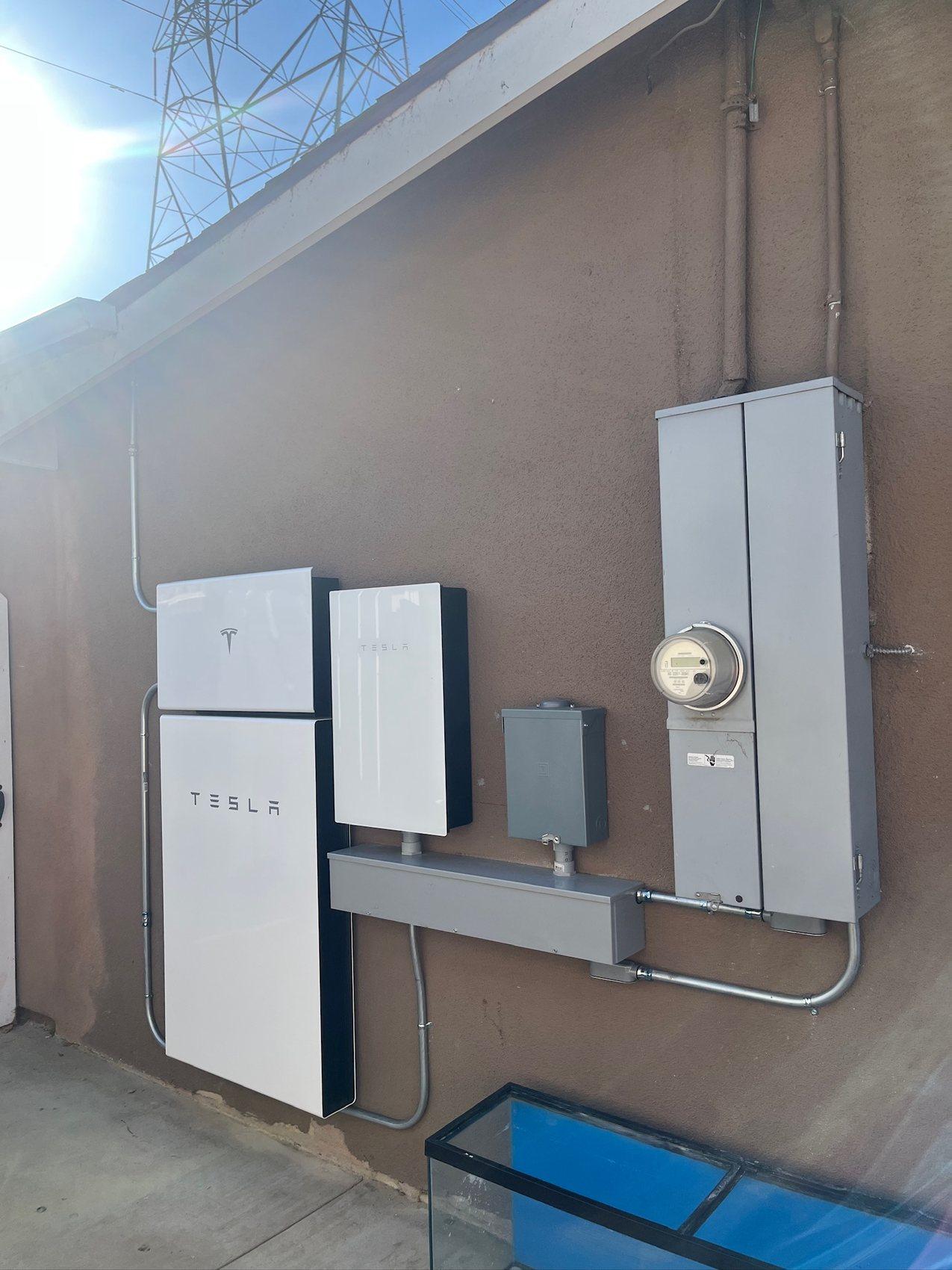
These are the three home batteries leading the California market in 2026, and none of them is universally 'best' — each wins for a different kind of home. The Powerwall 3 integrates its own solar inverter and delivers the highest continuous power, making it the strongest fit for new solar-plus-battery installs and heavy loads. The Enphase IQ Battery 10C is AC-coupled and pairs cleanly with existing or microinverter solar, with the longest warranty. The FranklinWH aPower 2 stores the most energy per unit and its aGate controller is built around whole-home management, including generator integration.
Here is the short version side by side. For the full breakdown — installation architecture, surge ratings, app ecosystems, and which homes each one wins — see our complete Powerwall 3 vs. Enphase vs. FranklinWH comparison. Ready to pick one? See our ranked 2026 best-battery picks →.
Pricing note, September 2026: $9,995 is for a basic installation with Participate Energy. Final pricing depends on the custom configuration and selected plan. Compare the ownership/payment terms and installation scope, not just the starting price. See our Powerwall cost guide for the configuration details.
| Spec | Tesla Powerwall 3 | Enphase IQ Battery 10C | FranklinWH aPower 2 |
|---|---|---|---|
| Usable capacity | 13.5 kWh | 10 kWh | 15 kWh |
| Continuous power | 11.5 kW | Modular AC-coupled output (lower per unit) | 10 kW |
| Chemistry | LFP (lithium iron phosphate) | LFP (lithium iron phosphate) | LFP (lithium iron phosphate) |
| Warranty | 10 years | 15 years | 15 years |
| Architecture | DC-coupled, integrated solar inverter | AC-coupled, pairs with Enphase microinverters | AC-coupled, aGate whole-home controller |
| Installed range (OC Solar published) | $9,995–$15,995 ($9,995 basic installation with Participate Energy) | $13,000-$17,000 | $15,000-$19,000 |
| Best for | New solar-plus-battery, EVs, heavy AC loads | Existing/microinverter solar, longest-warranty priority | Whole-home backup capacity, generator integration |
Specs per each manufacturer's published documents as of 2026 and subject to manufacturer updates; installed ranges are OC Solar's published figures, before incentives. The right platform depends on your home and existing equipment — we recommend in an itemized proposal, not by default.
Battery backup without solar: does it work in California?
Yes — you can install a home battery without solar panels, and for some households it is the right call. A standalone battery charges from the grid during cheap off-peak hours and discharges during the 4-9 PM peak, so it still captures a version of the time-of-use spread, and it delivers the same automatic outage protection: when the grid drops, the home islands onto the battery in a fraction of a second.
The honest trade-offs: without panels, the battery cannot recharge during a multi-day outage — once the stored energy is spent, you wait for the grid — while a solar-paired battery refills every morning for as long as an outage lasts. The daily economics are also narrower, since you are arbitraging the gap between off-peak and peak grid prices rather than storing power your roof produced. Renters with permission, homes with heavy shading, and households whose priority is medical-equipment or work-from-home reliability are the typical standalone fits.
Standalone storage goes through the same permit and utility-approval process as solar-paired storage, and we install it the same way — with an itemized scope and a load plan. If solar is viable on your roof, we will show you both designs priced side by side, because the paired system usually wins on ten-year economics. Grid-charging economics by utility, standalone SGIP rules, and renter and condo scenarios are all in the full standalone-battery guide →.
Permits, inspection, and utility approval
Every battery installation in California goes through a permit with your city or county building department, a field inspection, and approval from your utility before the system can operate in backup and TOU modes. Batteries add a few wrinkles beyond solar-only scope — fire-setback and clearance rules for the mounting location, main-panel capacity checks, and backup-control hardware that the inspector will want to see — which is one reason installed prices vary by city and home.
A good installer runs all of it for you: plan sets, permit submission, inspection scheduling, and the utility interconnection paperwork. We handle battery, electrical, and permitting with in-house crews rather than subcontractors, and our California permit and interconnection guide walks through the timeline city by city so you know what to expect.
How OC Solar designs battery backup
We have installed solar, battery, and electrical work across Orange County and Southern California since 2016 — more than 30 megawatts to date, with a 4.8-star Google rating. On batteries specifically, OC Solar is a Tesla Powerwall Premier Certified installer and one of just 12 installers on Tesla's Powerwall Pro Council, and we install and service the Enphase platform as well; our FranklinWH assessments are market analysis built on the manufacturer's published specs and California pricing — so the recommendation follows your home, not a single product line.
A battery design from us starts with your actual usage data and rate plan, models your 4-9 PM consumption and backup priorities, and lands on an itemized proposal: battery count, backup scope, electrical work, permits, and the honest incentive picture — nothing propped on a rebate you cannot get. If you are weighing how a monthly payment compares to the bill it replaces, our financing comparison lays out cash, loan, and $0-down structures side by side.
Start with a free estimate — we will size the battery to your home, show the assumptions next to the price, and tell you plainly if your situation is one where a battery does not pencil yet.
FAQ
In 2026, most installed home battery systems in California run about $13,000 to $19,000 before incentives. OC Solar's published installed ranges are $9,995–$15,995 ($9,995 basic installation with Participate Energy) for the Tesla Powerwall 3, $13,000-$17,000 for the Enphase IQ Battery 10C, and $15,000-$19,000 for the FranklinWH aPower 2, and EnergySage's July 2026 marketplace data benchmarks California storage at about $1,074 per installed kWh. Battery count, backup scope, and electrical-panel work move the total, so compare itemized quotes covering the same scope.
Yes. A standalone home battery charges from the grid during cheap off-peak hours, discharges during the expensive 4-9 PM peak, and provides automatic backup power during outages. The trade-off is that without solar it cannot recharge during a multi-day outage, and the daily savings are narrower because you are arbitraging grid rates rather than storing your own solar. If your roof supports solar, the paired system usually wins on long-term economics.
There is no universal best — the right battery depends on your home. The Tesla Powerwall 3 (13.5 kWh, 11.5 kW continuous) is the strongest fit for new solar-plus-battery installs and heavy loads like EV charging and central AC. The Enphase IQ Battery 10C (10 kWh, 15-year warranty) pairs cleanly with existing or microinverter solar. The FranklinWH aPower 2 (15 kWh, 10 kW, 15-year warranty) stores the most per unit and is built around whole-home energy management. All three use safe LFP chemistry.
Size to your usage, not a template. The average California home uses about 503 kWh a month — roughly 16.5 kWh a day — so a single 13.5-15 kWh battery covers evening peak usage plus essentials backup for most small-to-medium homes. Whole-home backup, EV charging, or central AC typically calls for two to three units. For daily savings under NEM 3.0, the battery mainly needs to cover your 4-9 PM consumption; for outages, it needs to cover your protected loads for the hours you want to ride through.
Not the ones most people expect. The 30% federal residential credit (Section 25D) expired December 31, 2025, so cash and loan buyers get no federal residential tax credit in 2026 — on a lease or PPA, the financier claims the separate commercial Section 48E credit and passes value through as lower pricing, through about 2027. California's SGIP general budgets largely closed at the end of 2025, leaving limited income-qualified pathways. The property-tax exclusion for active solar remains for systems qualifying before January 1, 2027.
It depends on what you run. Backing up essentials — refrigerator, LED lights, Wi-Fi, and a TV — a 13.5 kWh battery like the Powerwall 3 runs roughly a day and a half; add central AC and runtime drops to a few hours, since a 3-ton unit uses about 3.1 kWh every hour. Paired with solar, the battery recharges each morning and can carry essentials indefinitely through a multi-day outage. OC Solar's battery runtime calculator estimates your own appliance mix.
Yes — riding through Public Safety Power Shutoffs is one of the main reasons California homes add batteries. When the utility de-energizes lines during fire-risk weather, the battery's gateway or controller automatically islands your home and keeps protected circuits running. Solar panels alone shut off during any outage for safety, but panels paired with a battery keep producing: they recharge the battery each day for as long as the shutoff lasts.
Sources
- 1.EnergySage — California energy storage cost data — EnergySage · accessed 2026-08
- 2.Tesla — Powerwall 3 Datasheet — Tesla · accessed 2026-08
- 3.Enphase — IQ Battery home storage — Enphase · accessed 2026-08
- 4.FranklinWH — aPower 2 home battery backup — FranklinWH · accessed 2026-08
- 5.CPUC — Self-Generation Incentive Program (SGIP) — California Public Utilities Commission · accessed 2026-08
- 6.CPUC — Net Energy Metering Revisit (NEM 3.0 / Net Billing Tariff) — California Public Utilities Commission · accessed 2026-08
- 7.SCE — Time-of-Use residential rate plans — Southern California Edison · accessed 2026-08
- 8.IRS — Residential Clean Energy Credit (Section 25D) — Internal Revenue Service · accessed 2026-08
Choose the appliances you need during an outage and compare a battery design for your home.
Plan my backup power →